
There’s a wealth to do and see in and around Madison Square.
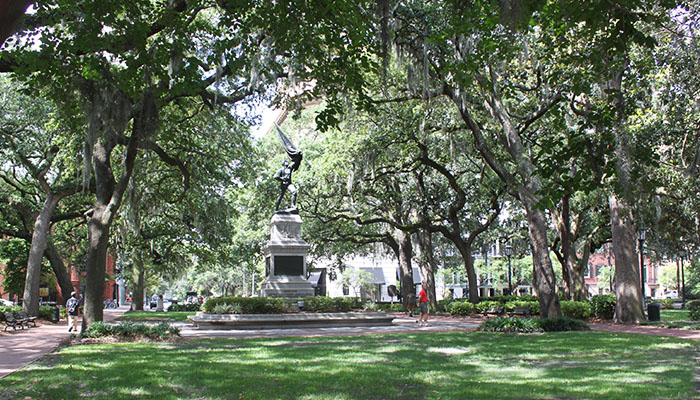
It all starts with the 15- and- a- half-foot bronze monument of Sergeant William Jasper in the middle of everything. There’s a plethora of history, and even some rumored hauntings, in and around the square. Madison Square houses many nice restaurants and shops, as well.
The square was designed in 1837, laid out in 1839. The square boasts beautiful examples of Greek revival, Gothic, and Romanesque architecture.
The monument of Jasper, an American soldier in the Revolutionary War, stands tall to honor the sergeant. Just northwest of the marker, Sgt. Jasper died during the Siege of Savannah on October 9, 1779,
Alexander Doyle, a distinguished sculptor in New York, designed the monument. The piece depicts Jasper holding his bullet wound with his right hand. Yet, he still stands tall with his holey, bullet-ridden hat at his feet.
On each side of the monument’s foundation, there is a bas-relief to show the Jasper’s military career: the barricade at Fort Sullivan, where Jasper replaced the flag under heavy fire, the freeing of prisoners near Savannah, and finally, his last moments.
 Green-Meldrim House


The two cannons on the south side of the square note the beginning of the first highways in Georgia – the Augusta Road and the road to Darian, now known as Ogeechee Road.
The square is in the company of Green-Meldrim House.
Now a museum, architect John S. Norris of New York designed it in the Gothic Revival style. Built in 1853 for English cotton merchant Charles Green, General William Sherman headquartered his confederate troops there. His troops used the Green-Meldrim House from Dec. 22, 1864 until Feb. 1, 1865.
Next to the Green-Meldrim House is St. John’s Episcopal Church, which was built in 1853 from the Gothic Revival style designs of Calvin N. Otis of Buffalo of New York. Also on the square is the Sorrell-Weed House, designed in Greek Revival style by Charles Cluskey, a prominent architect in the United States who even worked on the capital. It was completed in 1840 for Francis Sorrell and many parties were thrown there, with guests including General William Sherman and Robert E. Lee.